draw a mechanism for this reaction. interactive 3d display mode
ane What do we mean past mechanism?
The mechanism of a chemical reaction is the sequence of actual events that take place as reactant molecules are converted into products. Each of these events constitutes an elementary step that can be represented as a coming-together of discrete particles ("collison") or as the breaking-up of a molecule ("dissociation") into simpler units. The molecular entity that emerges from each step may be a concluding product of the reaction, or it might be an intermediate — a species that is created in 1 unproblematic step and destroyed in a subsequent step, and therefore does not appear in the net reaction equation.
For an case of a machinery, consider the decomposition of nitrogen dioxide into nitric oxide and oxygen. The net balanced equation is
two NOii (yard) → ii NO(g) + O2 (g)
The machinery of this reaction is believed to involve the post-obit ii uncomplicated steps:
i) 2 NO2 → NOiii + NO
2) NOthree → NO + O2
Annotation that the intermediate species NO3 has simply a transient existence and does not appear in the cyberspace equation.
A useful reaction mechanism
- consists of a serial of elementary steps (divers beneath) that can be written every bit chemical equations, and whose sum gives the net balanced reaction equation;
- must agree with the experimental rate law;
- can rarely if ever exist proved absolutely.
Information technology is important to understand that the mechanism of a given cyberspace reaction may be unlike under different weather. For example, the dissociation of hydrogen bromide 2 HBr(chiliad) → H2 (chiliad) + Brtwo (thou) gain by dissimilar mechanisms (and follows dissimilar charge per unit laws) when carried out in the nighttime (thermal decomposition) and in the light (photochemical decomposition).
Similarly, the presence of a catalyst tin can enable an alternative mechanism that profoundly speeds upwards the rate of a reaction.
Unproblematic steps
A reaction mechanism must ultimately exist understood as a "blow-by-blow" description of the molecular-level events whose sequence leads from reactants to products. These elementary steps (also called uncomplicated reactions) are almost ever very elementary ones involving one, two, or [rarely] iii chemical species which are classified, respectively, as
| unimolecular | A → | by far the virtually mutual |
| bimolecular | A + B → | |
| termolecular | A + B + C → | very rare |
Elementary reactions differ from ordinary net chemical reactions in two important ways:
- The rate constabulary of an elementary reaction can be written by inspection. For example, a bimolecular procedure always follows the second-order charge per unit police
k[A][B]. - Elementary steps frequently involve unstable or reactive species that exercise non appear in the cyberspace reaction equation.
Some net reactions practise go along in a unmarried elementary step, at least under certain conditions. But without careful experimenation, one can never exist sure.
The gas-stage formation of Hullo from its elements was long thought to be a unproblematic bimolecular combination of Htwo and I2, but it was later found that under certain conditions, information technology followes a more complicated charge per unit law.
2 Multi-step (sequent) reactions
Mechanisms in which i uncomplicated step is followed past another are very common.
step one: A + B → Q
stride ii: B + Q → C
net reaction: A + 2B → C
(Equally must always be the case, the net reaction is just the sum of its elementary steps.) In this case, the species Q is an intermediate, usually an unstable or highly reactive species.
If both steps proceed at similar rates, charge per unit police experiments on the cyberspace reaction would not reveal that two separate steps are involved here.The rate law for the reaction would be
charge per unit = thousand[A][B]2
(Bear in heed that intermediates such as Q cannot appear in the rate law of a net reaction.)
When the rates are quite unlike, things can get interesting and lead to quite varied kinetics besides as some simplifying approximations.
Some of import simplifying approximations
When the rate constants of a series of consecutive reactions are quite dissimilar, a number of relationships can come into play that profoundly simplify our understanding of the observed reaction kinetics.
The rate-determining step
The rate-determining step is besides known equally the rate-limiting step.
We can more often than not expect that ane of the uncomplicated reactions in a sequence of consecutive steps will have a rate constant that is smaller than the others. The effect is to slow the rates of all the reactions — very much in the fashion that a line of cars creeps slowly up a hill behind a tedious truck.

The three-step reaction depicted here involves two intermediate species I1 and I2 , and three activated complexes numbered X1-three . Although the footstep I 2 → products has the smallest individual activation energy Eastwarda three, the energy of X3 with respect to the reactants determines the activation energy of the overall reaction, denoted by the leftmost vertical pointer
  . Thus the rate-determining step is Iii → products.
Chemists ofttimes refer to elementary reactions whose forrard charge per unit constants have large magnitudes every bit "fast", and those with forward small rate constants as "deadening". Always bear in heed, however, that as long equally the steps go on in single file (no short-cuts!), all of them will proceed at the same charge per unit. So even the "fastest" members of a consecutive series of reactions will proceed as slowly every bit the "slowest" i.
Rapid equilibria
In many multi-footstep processes, the forrad and reverse rate constants for the germination of an intermediate Q are of similar magnitudes and sufficiently big to make the reaction in each direction quite rapid. Decomposition of the intermediate to production is a slower process:
A  Q
Q  B
B
This is often described equally a rapid equilibrium in which the concentration of Q tin can be related to the equilibrium constant K = grandi /g–1 (This is just the Police force of Mass Activity.). It should be understood, however, that true equilibrium is never achieved because Q is continually existence consumed; that is, the charge per unit of formation of Q always exceeds its rate of decomposition. For this reason, the steady-country approximation described beneath is mostly preferred to treat processes of this kind.
The steady-state approximation
Consider a mechanism consisting of two sequential reactions
A  Q B
Q B
in which Q is an intermediate. The time-vs-concentration profiles of these three substances will depend on the relative magnitudes of k 1 and k ii, as shown in the following diagrams.
Structure of these diagrams requires the solution of sets of simultaneous differential equations, which is [fortunately!] across the scope of this course.

The steady-state approximation is commonly not covered in introductory courses, although information technology is not peculiarly complicated mathematically. For a nice introduction, see this U. Waterloo tutorial.
In the left-hand diagram, the rate-determining step is conspicuously the conversion of the rapidly-formed intermediate into the product, so there is no demand to formulate a rate law that involves Q. But on the correct side, the germination of Q is rate-determining, only its conversion into B is then rapid that [Q] never builds up to a substantial value. (Discover how the plots for [A] and [B] are almost mutually changed.) The upshot is to maintain the concentration of Q at an approximately constant value. This steady-country approximation can greatly simplify the analysis of many reaction mechanisms, especially those that are mediated by enzymes in organisms.
How alternative mechanisms can affect rate laws
Example ane: A + B → C
One possible mechanism might involve two intermediates Q and R:
The rate law corresponding to this mechanism would be that of the charge per unit-determining step: charge per unit = k 1[A][B].
An alternative mechanism in which the rate-determining pace involves i of the intermediates would brandish tertiary-order kinetics:
Since intermediates cannot appear in rate law expressions, we must express [Q] in the rate-determining step in terms of the other reactants. To do this, nosotros brand use of the fact that Footstep 1 involves an equilibrium constant Thousand 1:

Solving this for [Q], we obtain [Q] = K 1[A][B].
Nosotros can now express the rate law for 2 as
rate = k 2 K 1[A][B][A] = k[A]2[B]
in which the constants k 2 and M 1 have been combined into a single constant k.
What'south the use of all this? The respond is that because we are unable to wait directly at the simple steps hidden within the "black box" of the reaction mechanism, we are limited to proposing a sequence that would be consistent with the reaction club which nosotros tin can observe. Chemical intuition can guide u.s.a. in this, for example past guessing the magnitudes of some of the activation energies. In the stop, however, the best nosotros can do is to piece of work out a machinery that is plausible; we can never "prove" that what nosotros come up with is the bodily mechanism.
Example 2: F2 + 2 NOii → ii NO2F
Application of the "chemical intuition" mentioned in the above box would atomic number 82 us to suspect that any process that involves breaking of the strong F–F bond would likely be slow enough to be charge per unit limiting, and that the resulting atomic fluorines would be very fast to react with another odd-electron species:
If this mechanism is right, then the rate police force of the net reaction would be that of the rate-determining step:
rate = thousand 1[F2][NOtwo]2
Example iii: Decomposition of ozone
Ozone is an unstable alltrope of oxygen that decomposes back into ordinary dioxygen according to the cyberspace reaction
2 Oiii → 3 Otwo
A possible machinery would be the simple one-step bimolecular collision suggested by the reaction equation, but this would lead to a second-order rate law which is non observed. Instead, experiment reveals a more complicated rate law:
rate = [O3]two[Otwo]–i
What's this? It looks as if O2 really inhibits the reaction in some fashion. The generally-accepted mechanism for this reaction is:
Does this seem reasonable? Note that
- The equilibrium in Stride one should exist quite rapid considering ozone's instability predicts a low activation free energy for the forrad process. The aforementioned tin be said for the contrary procedure which involves the highly reactive oxygen atom which we would look to rapidly gobble up one of the nonbonding electron pairs on the O2 molecule.
- The inhibitory event of O2 can be explained by the LeChâtelier upshot — existence a production of the equilbrium in 1, buildup of oxygen forces it back to the left.
- In Step 2, one might wait the O atom to react with ozone equally speedily as it does with O2 in the contrary of Stride ane, but other studies bear witness that this is not the case. The rate abiding k 2 is probably adequately large. Given the strong covalent bond in O2, nosotros not look whatever significant reverse reaction.
To interpret this mechanism into a rate constabulary, we first write the equilibrium constant for Step 1 and solve it for the concentration of the intermediate:


Nosotros substitute this value of [O] into the rate expression [O][O3] for Step 2, which yields the experimentally-obtained charge per unit law

Example iv: a reaction having an apparently negative Ea
ii NO + O2 → 2 NOii
The gas-stage oxidation of nitric oxide, like most tertiary-order reactions, is non termolecular but rather a combination of an equilibrium followed by a subsequent bimolecular step:
Since the intermediate Due north2Otwo may not announced in the rate equation, nosotros need to limited its concentration in terms of the reactant NO. As in the previous example, we do this through the equilibrium constant of Step 1:
K = [N2Oii] / [NO]2 [N2O2] = Thou [NO]ii
charge per unit = k two [N2Oii ][O2] = k 2 K [NO]2 [O2]
The unusual feature of this net reaction is that its rate diminishes as the temperature increases, suggesting that the activation energy is negative. Reaction 1 involves bond formation and is exothermic, and so equally the temperature rises, K decreases (LeChâtelier effect). At the same time, k2 increases, but non sufficiently to overcome the decrease in K. So the obviously negative activation energy of the overall process is just an artifact of the magnitudes of the opposing temperature coefficients of chiliadii and 1000. Encounter hither for more comment on this unusual effect.
three Chain reactions
Gratuitous radicals
Many important reaction mechanisms, particularly in the gas phase, involve intermediates having unpaired electrons, usually known every bit gratis radicals. Free radicals are often fairly stable thermodynamically and may be quite long-lived by themselves, but they are highly reactive, and hence kinetically labile.
The dot ·, representing the unpaired electron, is not really a part of the formula, and is usually shown simply when we want to emphasize the radical character of a species.
The "atomic" forms of many elements that normally form diatomic molecules are free radicals; H·, O·, and Br· are common examples. The simplest and well-nigh stable (ΔG = +87 kJ/mol) molecular free radical or "odd-electron molecule" is nitric oxide, NO·.
The most important chemical property of a free radical is its ability to pass the odd electron along to another species with which information technology reacts. This concatenation-propagation process creates a new radical which becomes capable of initiating some other reaction. Radicals can, of form, also react with each other, destroying both ("chain termination") while creating a new covalent-bonded species.
Chain reaction mechanisms
 Much of the pioneering work in this field, of which the HBr synthesis is a classic example, was done by the German chemist Max Bodenstein (1871-1942)
The synthesis of hydrogen bromide from its elements illustrates the major features of a concatenation reaction. The figures in the correct-hand column are the activation energies per mole.
| 1 Br2 + M → 2 Br· | chain initiation (ΔH° = +188 kJ) |
| 2 Br· + H2 → H· + HBr | chain propagaton (+75 kJ) |
| iii H· + Brtwo → HBr + Br· | chain propagation (–176 kJ) |
| 4 H· + HBr → Htwo + Br· | chain inhibition (–75 kJ) |
| 5 ii Br· + M → One thousand* + Br2 | chain termination (–188 kJ) |
Note the following points:
- To start the reaction, a complimentary radical must exist formed (1). If the temperature of the gas is fairly high, then Br· can exist formed from the more energetic collisions of Br2 molecules with some other molecule Grand (most likely a 2d Br2). This is known as thermal activation; Some other way of creating gratis radicals is photochemical activation.
- Reactions 2 and 3 consume a free radical only form another, thus "propagating" the concatenation.
- In reaction 4, a molecule of the product is destroyed, thus partially un-doing the internet process.
- If the only the first four reactions were active, then the bike would continue indefinitely. But reaction 5 consumes the Br· chain carrier without producing new radicals, thus terminating the chain. The function of the molecule Grand is to absorb some of the kinetic free energy of the collision so that the 2 bromine atoms do not simply bounce apart. The production One thousand* represents a thermally-excited M which quickly dissipates its energy to other molecules.
- Other reactions, such equally the recombination of hydrogen atoms, likewise take place, simply their contribution to the overall kinetics is usually very small.
The charge per unit laws for chain reactions tend to be very complex, and often have non-integral orders.
Branching chain reactions: explosions
The gas-stage oxidation of hydrogen has been extensively studied over a broad range of temperatures and pressures.
H2 (g) + ½ O2 (chiliad) → HiiO(g) ΔH° = –242 kJ/mol
This reaction does not take identify at all when the 2 gases are merely mixed at room temperature. At temperatures effectually 500-600°C it proceeds quite smoothly, but when heated above 700° or ignited with a spark, the mixture explodes.
As with all combustion reactions, the mechanism of this reaction is extremely complex (you don't want to see the rate law!) and varies somewhat with the conditions. Some of the major radical formation steps are
The species HO2· is known as perhydroxyl; HO· is hydroxyl (non to exist dislocated with the hydroxyl ion HO:–)
| 1 H2 + O2 → HOii· + H· | concatenation initiation |
| 2 H2 + HO2· → HO· + H2O | chain propagaton |
| three H· + O2 → HO· + O· | chain propagaton + branching |
| 4 O· + H2 → HO· + H· | chain propagation + branching |
| five HO· + H2 → H2O + H· | chain propagation |
Reactions 3 and 4 give birth to more radicals than they consume, so when these are active, each one effectively initiates a new chain process causing the rate overall charge per unit to increase exponentially, producing an explosion.
Near explosions
An explosive reaction is a highly exothermic procedure that once initiated, goes to completion very apace and cannot be stopped. The distructive force of an explosion arises from the rapid expansion of the gaseous products as they absorb the heat of the reaction.
At that place are two basic kinds of chemical explosions:
Thermal explosions occur when oestrus is released by a reaction more quickly than it can escape from the reaction infinite. This causes the reaction to proceed more rapidly, releasing even more heat, resulting in an always-accelerating runaway rate.
Concatenation-branching explosions occur when the number of chain carriers increases exponentially, effectively seeding new reaction centers in the mixture. The process so transforms into a thermal explosion.
Explosion limits
Whether or not a reaction proceeds explosively depends on the balance between formation and devastation of the chain-conveying species. This balance depends on the temperature and pressure, equally illustrated here for the hydrogen-oxygen reaction.
- Direct recombination of concatenation carriers generally requires a three-body collision with another molecule to absorb some of the kinetic free energy; such ternary processes are unlikely at very low pressures. Thus below the lower explosion limit , the radicals (including those produced by a spark) are usually able to reach the walls of the container and combine there — or in the case of an open up-air explosion, simply combine with other molecules as they go out the agile volume of the reaction.
- Within the explosion zone between and
 (which, for about gases, are known as the lower- and upper explosion limits), the propagation and branching processes operate efficiently and explosively, fifty-fifty when the mixture is heated homogeneously.
 - In a higher place , the concentration of gas molecules is sufficient to enable ternary collisions which allow chain-termination processes to operate efficiently, thus suppressing branching. Higher up this upper limit, reactions involving most gases proceed smoothly.
- Hydrogen is unusual in that information technology exhibits a 3rd explosion limit . The cause of this was something of a mystery for some time, but it is now believed that explosions in this region do not involve branching, but are thermally induced by the reaction
HO2· + H2 → H2O2 + H· .

The lower exposion limit of gas mixtures varies with the size, shape, and composition of the enclosing container. Needless to say, experimental decision of explosion limits requires some care and creativity.
Upper and lower explosion limits for several common fuel gases are shown below. [source]


What you should exist able to practice
Brand certain yous thoroughly understand the following essential ideas which have been presented to a higher place. It is especially imortant that you know the precise meanings of all the green-highlighted terms in the context of this topic.
- Explain what is meant by the mechanism of a reaction.
- Define an elementary reaction, and state how it differs from an ordinary net chemical reaction.
- Sketch out an activation free energy diagram for a multistep mechanism involving a rate-determining step, and relate this to the activation free energy of the overall reaction.
- Write the rate law expression for a ii-step mechanism in which the rate constants accept significantly different magnitudes.
- Write the rate constabulary expression for a three-footstep reaction in which one pace is a rapid equilibrium, and the other two steps have significantly dissimilar magnitudes.
- Define a chain reaction, and listing some of the different kinds of steps such a reaction will involve.
- Define a branching chain reaction, and explain how such reactions can lead to explosions.
Concept map
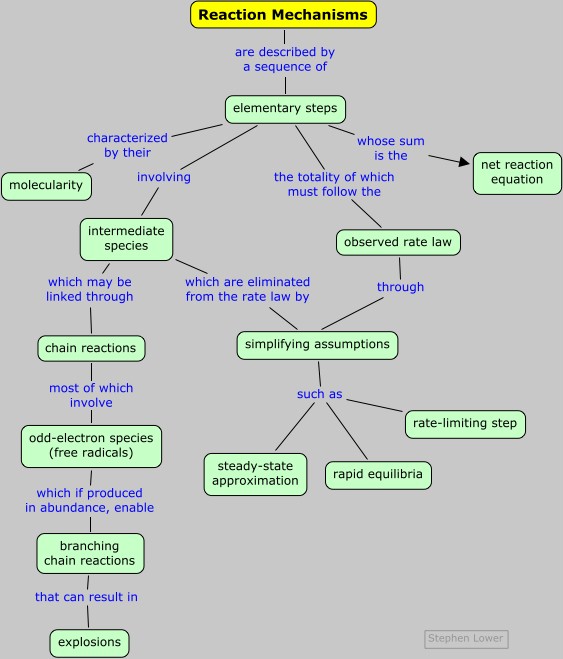
Source: https://chem1.com/acad/webtext/dynamics/mech.html

Post a Comment for "draw a mechanism for this reaction. interactive 3d display mode"