Bose Quiet Comfort 20i Noise Cancelling Headphones Blue
Test Results
Design

The Bose QuietComfort 20 are good-looking earbuds. The cable is rubberized and black, with blue accents for style. The flat rectangular noise isolation generator is latex coated and also has the same blue accent for the on/off button. The StayHear+ tips are curved and designed to fit most ears.

Weight 0.09 lbs
Clamping Force 0 lbs
The QC20 have a comfortable earbud design that doesn't enter the ear canal like most in-ear headphones. This makes them comfortable enough to wear for long listening sessions without any listening fatigue. Unlike the over-ear Bose QuietComfort 25, these headphones don't cause too much discomfort when the noise-cancellation feature is enabled.

OS Compatibility iOS
Ease Of Use Great
Feedback Decent
Call/Music Control Yes
Volume Control Yes
Microphone Control No
Channel Mixing No
Noise Cancelling Control On/Off
Talk-Through On/Off
Additional Controls No
The Bose QuietComfort 20 have a straightforward and efficient control scheme. The buttons are well spaced out and provide all the essential functions; call/music, track skipping and volume controls. The buttons deliver good feedback and the Control Module is very thin and easily fits in tight pockets.

Avg.Temp.Difference 1.1 °C
The Bose QC20 have a breathable design that won't make your ears sweat more than usual. They trap a bit of heat within the notch of your ear due to their earbud tips and stability fins, but they won't cause a big difference in temperature even during more intense workouts.

L 4.7" (11.9 cm)
W 1.6" (4.1 cm)
H 1.2" (3.0 cm)
Volume 8.80 in³ (144.21 cm³)
Transmitter Required No
The Bose QC20 are very portable headphones. They don't take too much space and will comfortably fit into your pockets, purse or bag. The control module makes them a little larger than basic in-ear headphones but is flat enough to not add additional bulk to the design.
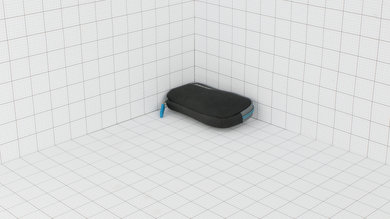
Type Soft case
L 5.1" (13.0 cm)
W 2.8" (7.1 cm)
H 0.8" (2.0 cm)
Volume 11.20 in³ (183.53 cm³)
These earbuds come with a soft fabric case that will protect the headphones from scratches and prevent them from getting tangled in your bag. It also doesn't add much bulk to the already small headphones so it will still fit in your pocket or bag. However, the soft fabric will not shield your headphones from water damage or high physical stress.

The Bose QuietComfort 20 have a good build quality. The control module and earbuds are dense and durable enough to withstand multiple accidental drops. The cables are also thick and won't easily get damaged by wear and tear unlike some of the cheaper in-ears we've tested. However, the latex cover on the Control Module peels off relatively easily after repeated use but doesn't actually damage the module so it's more of a cosmetic issue.

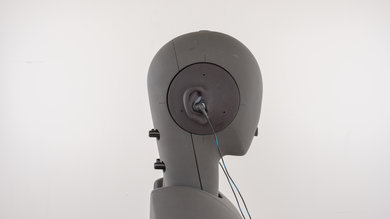
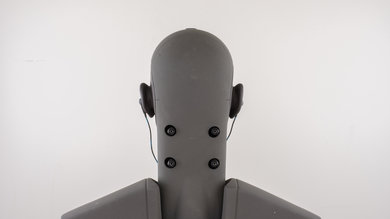
These are stable earbuds that won't easily fall out of your ears. They offer a variety of stability tips that help them maintain their stable fit. They work well as gym headphones and are stable enough to be used while running. Unfortunately, they're not wireless, and the long cable can easily get hooked on something, which will pull the headphones out of your ears.




- Bose QuietComfort 20 Headphones
- 3 pairs StayHear®+ tips (S, M, L)
- USB cable
- Carrying case
Sound

Bass Amount 0.27 dB
Treble Amount -4.38 dB

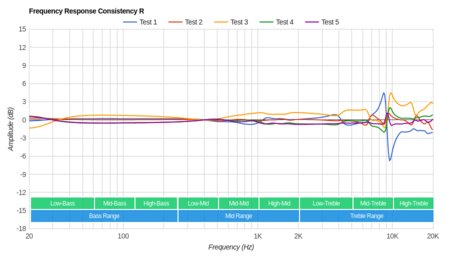
Avg. Std. Deviation 0.43 dB
The frequency response consistency of the QC20 is good. Due to their unique earbud design, if the user is able to achieve an air-tight seal with these headphones, then the bass delivery should be very consistent across multiple re-seat and individuals. The consistency in the treble range is also good, but it is dependent on the placement and more prone to inconsistencies.


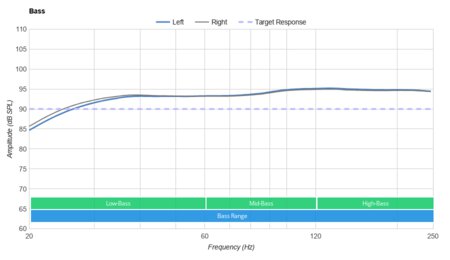
Std. Err. 3.65 dB
Low-Frequency Extension 22.45 Hz
Low-Bass 1.58 dB
Mid-Bass 4.02 dB
High-Bass 4.8 dB
The bass of the QuietComfort 20 is good. LFE (low-frequency extension) is at 21Hz, which is great, meaning they can produce very deep thump and rumbles. However, the entire bass range is consistently above our neutral target by more than 4dB. This makes the overall bass of the QC20 excessively heavy, which sounds boomy and drowns out vocals and other instruments in the mid-range.
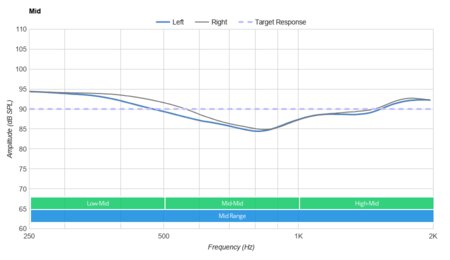
Std. Err. 3.03 dB
Low-Mid 3.16 dB
Mid-Mid -3.15 dB
High-Mid -0.02 dB
The Bose QC 20 has a mid-range performance. Low-mid is overemphasized by more than 3dB, which is the continuation of the bass overemphasis. This thickens the vocals and makes the mid-range sound cluttered and muddy. Additionally, the dip/recess centering 800Hz pushes vocals/leads slightly to the back of the mix, by giving more emphasis to the bass and treble frequencies.

Std. Err. 2.65 dB
Low-Treble 1.71 dB
Mid-Treble -1.73 dB
High-Treble -20.85 dB
The QC 20 has sub-par treble range performance. The response throughout the range is rather inconsistent. Low-treble is above our target by more than 2dB, bringing emphasis and projection to the upper harmonics of vocals and lead instruments, and giving a subtle V shape to the overall frequency response. The inconsistencies in mid-treble will make the production of sibilances (S and Ts) rather uneven. Additionally, the lacking high-treble means their sound headphones will lack airiness and brilliance.

Peaks 2.69 dB
Dips 1.51 dB
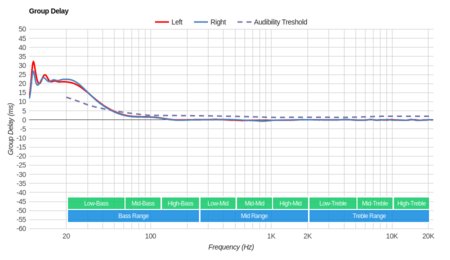

Weighted Group Delay 0.36
Weighted Phase Mismatch 1.92
Weighted Amplitude Mismatch 0.83
Weighted Frequency Mismatch 1.63
The imaging is great. Their weighted group delay is at 0.36, which is within good limits. But the GD graph shows that it crosses the audibility threshold below 50Hz, but not enough to have a significant effect. Additionally, the L/R drivers of our test unit were quite well-matched in amplitude, frequency, and phase response, ensuring an accurate placement and localization of objects (voices, instruments, video game effects) in the stereo image.
PRTF Accuracy (Std. Dev.) N/A
PRTF Size (Avg.) N/A
PRTF Distance N/A
Openness
Acoustic Space Excitation
The soundstage is poor. This is mainly due to their earbud design, since activating the resonances of the pinna (outer ear) is one of the key factors in creating a large and out-of-head soundstage and earbuds don't interact with the pinna. Also, their soundstage won't feel as open and spacious as that of closed-back in-ear's, because of their high degree of isolation.
Head Modeling No
Speaker Modeling No
Room Ambience No
Head Tracking No
Virtual Surround No App
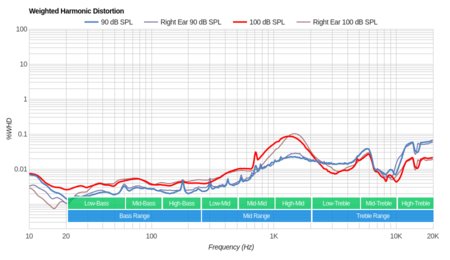
WHD @ 90 0.179
WHD @ 100 0.241
Firmware No Firmware
Power On
Connection Wired
Codec PCM, 24-bit, 48kHz
EQ No EQ
ANC On
Tip/Pad Silicone (small)
Microphone In-line
Isolation

Overall Attenuation -24.42 dB
Bass -23.88 dB
Mid -20.86 dB
Treble -28.06 dB
The isolation performance of the Bose QC20 is great. Once the active noise cancellation is enabled, they provide more than 23dB of isolation in the bass range, which is excellent for cancelling out the rumble of airplane and bus engines. In the mid-range, important for blocking out speech, they achieved about 22dB of isolation, which is also great. In the treble range, occupied by sharp S and Ts, they reduce outside noise by about 28dB, which is above average.
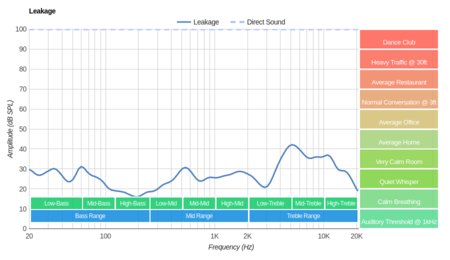
Overall Leakage @ 1ft 26.86 dB
The leakage performance is excellent. The significant portion of their leakage is concentrated in a narrow range in the treble. This means their leakage will sound very thin and mostly consist of S and Ts. The overall level of the leakage is also very quiet. With the music at 100dB SPL, their leakage at 1 foot away averages at 27dB, and peaks at around 41dB. Well below the noise floor of most offices.
Microphone
Integrated No
In-Line Yes
Boom No
Detachable Boom No

LFE 515.36 Hz
FR Std. Dev. 2.46 dB
HFE 17,984.02 Hz
Weighted THD 0.955
Gain 20.19 dB
The recording quality of the QC20's microphone is decent. In the bass range, they lack quite a bit, except for the area around 90Hz. This results in a recorded/transmitted speech that sounds noticeably thin. Their HFE (high-frequency extension) however, is at 18KHz, which is great. This, and the flat frequency response mean that speech will sound detailed and present, which makes it easy to understand.

SpNR 12.18 dB
Noise Gate No
Speech + Pink Noise Handling
Speech + Pink Noise Audio Sample
Speech + Subway Noise Handling
Speech + Subway Noise Audio Sample
Update 10/22/2021: These headphones have been updated to test bench 1.5. In this update, we made changes to the way we test noise handling. We now use a subjective evaluation of our audio clips. This new method has resulted in different results than what we had reported in our previous test bench. As a result, the scoring of this box has changed, and we have updated our results.
The in-line microphone has an okay noise handling performance. It has some trouble separating your voice from moderate ambient noise around you. If you're taking a call from a busy street, your voice won't be completely drowned out, but it may be harder for the other person to hear you clearly.
Active Features
Battery Type Rechargable
Continuous Battery Life 19 hrs
Additional Charges 0.0
Total Battery Life 19 hrs
Charge Time 1.8 hrs
Power-Saving Feature No
Audio While Charging Yes
Passive Playback Yes
Charging Port micro-USB
The Bose QC20 have a good battery life. They last around 19 hours and don't take too long to charge. They're also capable of playing audio when charging, which makes them good headphones use at the office or if you have access to a power source on the train or plane. Unfortunately, if you leave them on they will run out of battery because there is no auto-off timer.
App Name No App
iOS No
Android No
macOS No
Windows No
Equalizer No
ANC Control No
Mic Control No
Room Effects No
Playback Control No
Button Mapping No
Surround Support No
These headphones have no compatible app.
Connectivity
Bluetooth Version No Bluetooth
Multi-Device Pairing No
NFC Pairing No
Line Of Sight Range N/A
PC Latency (SBC) N/A
PC Latency (aptX) N/A
PC Latency (aptX HD) N/A
PC Latency (aptX-LL) N/A
iOS Latency N/A
Android Latency N/A
These headphones do not have any Bluetooth capabilities. If you wan't a bluetooth headset with a similar design to the QC 20 check out the Bose SoundSport Wireless, the QuietControl 30 or the SoundSport Free. For more Bluetooth headphone options check out our best wireless recommendations here.
The Quiet Comfort 20 have a wired connection with negligible latency.
Non-BT Line Of Sight Range N/A
Non-BT Latency N/A

Analog Audio Yes
USB Audio No
Detachable No
Length 4.33 ft (1.32 m)
Connection 1/8" TRRS
Analog/USB Audio Latency 0 ms
The Bose QC 20 have a 1/8 TRRS analog audio cable that does not have microphone compatibility with consoles.
Analog Audio Only
Wired USB No
Non-BT Wireless No
PS4 Analog Audio Only
PS4 Wired USB No
PS4 Non-BT Wireless No
PS5 Analog Audio + Microphone
PS5 Wired USB No
PS5 Non-BT Wireless No
Xbox One Analog Audio Only
Xbox One Wired USB No
Xbox One Non-BT Wireless No
Xbox Series X|S Analog Audio Only
Xbox Series X|S Wired USB No
Xbox Series X|S Non-BT Wireless No
Type No Base/Dock
USB Input No
Line In No
Line Out No
Optical Input No
RCA Input No
Dock Charging No
Power Supply No Base/Dock
The Bose QuietComfort 20 headphones do not have a base station or a dock. If you want a noise canceling headphone with a dock, then try the Turtle Beach Elite 800.
Compared To Other Headphones
The Bose QuietComfort 20 are good commuting headphones thanks to their strong isolation and compact design. They have comfortable earbud tips that you can wear for longer than most in-ear designs and they're fairly easy to use with a durable build quality. Unfortunately, they do not sound as good as some of the more recent releases by Bose and their wired design feels a bit limiting and compared to some of the newer wireless earbuds available on the market like those from Jaybird. See our recommendations for the best noise cancelling earbuds and the best earbuds for sound.
The Bose QuietControl 30/QC30 Wireless are a better option for most uses if you want to go wireless; however, for a wired earbud, the Bose QuietComfort 20/QC20 are a good choice. The QC 30 benefit from the greater range of a Bluetooth connection. They also have a bit more control over their noise cancelling feature when compared to the QC 20. On the upside, the QC 20 have no latency, since they are wired. They also have a slightly stronger noise isolation performance than the QC 30. Also, since they have a simple wired design, they are a bit more portable and will easily fit into your pockets, unlike the QC 30.
If you prefer a compact design you can easily carry around in your pocket, then go for the Bose QuietComfort 20/QC20. However, if you want a wireless over-ear, the Bose QuietComfort 35/QC35 Wireless 2016 are a great alternative. The QC 20 are wired earbuds that are comfortable enough to wear for long listening sessions. They also block a lot of noise in noisy conditions, thanks to their excellent noise canceling. They're a slightly better travel headphone for some, since they are a bit more compact than the QC 35, and their earbud fit is not as bulky on your head so you can fall asleep on the plane or train with no issues. On the other hand, the wireless QC 35 are a bit more practical for everyday casual use. They also have a much better sound quality, they're easier to use and versatile enough to use wired or wireless with most of your devices.
The Bose SoundSport Wireless have a similar design and overall score as the Bose QuietComfort 20 but have much different use cases. The SoundSport Wireless are a bit more practical for every day use and sports since there are no cables to hinder your movements. They also have a better-balanced sound quality that does not sound as bass-heavy/dark as the QC 20. The QC 20, on the other hand, are better travel and commuting headphones thanks to the strong noise cancellation that blocks a lot more noise than the semi-open of the SoundSport Wireless. They also have a longer battery life and no latency for watching videos since they are wired.
The Jaybird X3 Wireless are a slightly better and more versatile in-ear/earbud than the Bose QuietComfort 20/QC20. The Bose have excellent isolation which makes them a far better choice for commute and travel than the Jaybirds. They also have a more comfortable earbud fit that you can wear for longer than the Jaybird. On the other hand, the Jaybird are better and more convenient sports headphone thanks to their wireless design. They also have a better default sound quality and come with an EQ so you can customize them to sound the way you like, unlike the Bose.
The Bose QuietComfort 20/QC20 are better overall wired headphones than the Razer Hammerhead USB-C ANC. The Bose have a comfortable fit, a more neutral sound profile, and use a 1/8" TRRS cable, which some users may prefer. Their ANC feature is significantly better as they have an in-line battery to help power them.
+ Show more
Source: https://www.rtings.com/headphones/reviews/bose/quietcomfort-20-qc20

Post a Comment for "Bose Quiet Comfort 20i Noise Cancelling Headphones Blue"